Fire door inspection in Woodley
Sheltered schemes, small blocks and the doors residents rely on.
Get a priceSheltered housing is a building where fire doors matter more than most. Residents are older, some move slowly, and a few are asleep behind a shut door. A good fire door buys time for the staff and for the fire service to get to them. This page is about how we'd inspect a scheme like that around Woodley.
A typical scheme has a row of flats along a corridor, with a lounge, a laundry and an office. Maybe a lift, and at least one stair. Every flat door opens onto the corridor, doors across the corridor split it into sections, and there are exits at the ends. All of those are fire doors, and all of them are used from morning to night by people with walking frames and carers pushing trolleys.
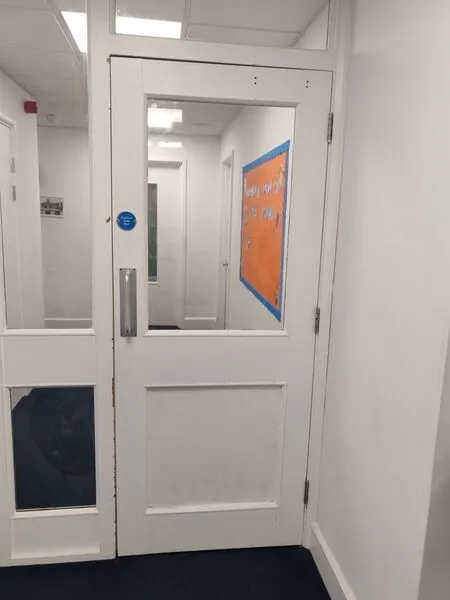
What the sheet looks like (invented examples)
Flat 12, entrance. Closer turned right down, door stops 15mm short of the latch. Gap under the door 7mm.
Corridor, east wing. Rubber wedge under the middle pair, kept in the cleaning cupboard.
Lounge. Laminated rota taped over the vision panel, covering the glass mark.
Laundry. Hinge side gap 6mm at the top, tapering to 3mm. The leaf has dropped.
Closers go first, because a resident with a frame can't push a heavy door and somebody turns the closer down. Hold-open devices come next. A proper magnet lets go when the alarm sounds, and a rubber wedge doesn't.
Who has to act
Article 17 of the Regulatory Reform (Fire Safety) Order 2005 is the maintenance duty, and it sits with the responsible person. In a housing association scheme that's the association, and in a privately run one it's the owner or operator. Royal Berkshire Fire and Rescue Service is the fire authority. Over 11 metres, the 2022 regulations add quarterly checks of communal doors and yearly checks of flat doors. Most schemes in a suburb are lower than that, which doesn't change what the doors have to do.
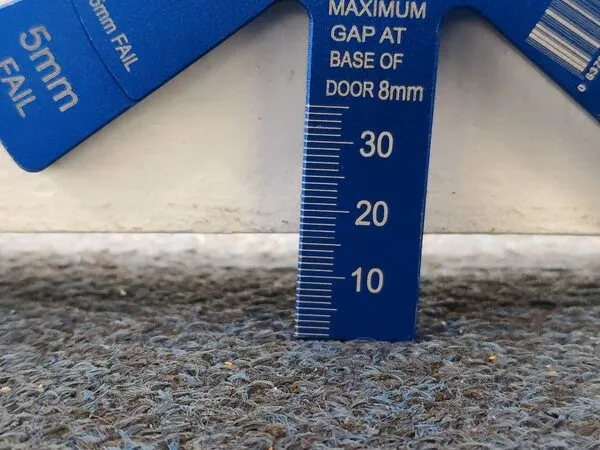
Planning round the residents
We ask the manager to let residents know we're coming, keep to the wing and time we've agreed and never go into a flat unless we're let in. Some residents will want to talk about the door, or the weather, or who we are, and we don't rush them. Most of the work is in the corridors anyway. A scheme of 25 flats is a long morning or a day, which with the communal doors added comes to something like 35 to 40 doors.
Next steps
Send us the postcode, the number of flats and whether there's a lift. We'll come back with a price the same day. We drive over from Luton, so we book a day and arrange access with your manager first.
Questions we get asked
Do you check the flat doors too?
Yes, if residents let us in. We note any we couldn't reach.
What about hold-open devices?
We check that they release when the alarm sounds. If a door is being held with something else, we report it.
Send us the postcode and a rough door count and we will come back with a price the same day.
Get a price