What the report contains
One entry per door, written for the person who has to decide what to do.
Get a priceHold up any door in your building and ask three questions. What is wrong with it? How bad is that? What will it take to put right?
The report answers those three for every door, in that order.
The entry for one door
Each door has a reference and a location. First floor landing, flat entrance, bar cellar, whatever matches the building.
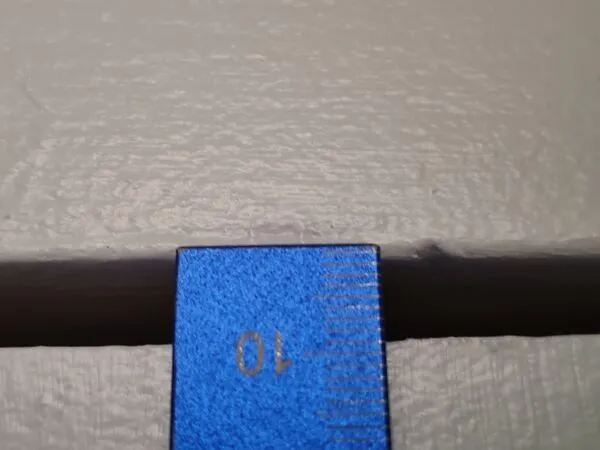
Under that are the photos. One of the whole door, then close-ups of the gap, hinge, closer or seal if something is off.
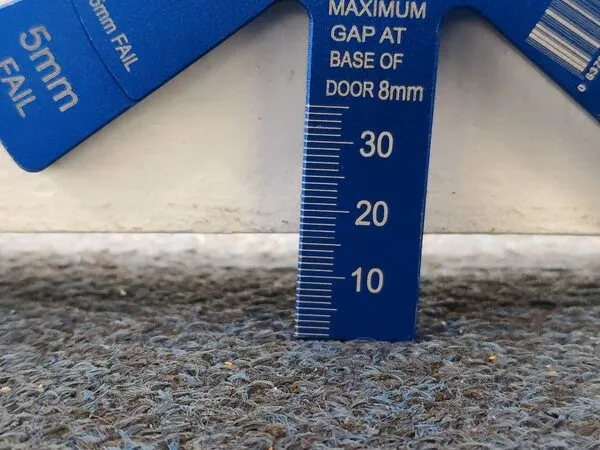
Next, the measurements. The gaps at the top, down both sides and at the bottom.
Next, what we found on the door, frame, hinges, closer, seals, glass and signs.
Last, a result and a note on what would fix it.
Putting faults in order
We rank them so you can budget.
A missing sign is low. A seal painted over is medium. A closer that will not shut the door is high. A hole through the leaf, or a door that is not there at all, is the top of the list and we say so on the day.
What the wording looks like
This one is made up to show the style. Entry 14, second floor landing, flat entrance. Top gap about 5mm at the hinge end, tightening towards the latch. Two hinge screws missing from the lower hinge. Closer present, door stops short of the latch. Seal intact on the frame, painted on the door edge. Medium urgency. Refit screws, adjust the closer, strip the paint from the seal.
That is the length of most entries. It is short because you have to be able to act on it.
What you can do with it
Hand it to your fire risk assessor. They may use it to update their action plan.
Send it to the managing agent or the owner. It saves them having to walk the building.
Give it to a carpenter. They can price from it without going door to door first.
Keep it. Next year's inspection can be set against it, and you can see which problems have come back.
What it cannot do
It cannot make a door pass. It tells you where you stand.
It cannot prove a door has a fire rating if there is no label, plug or glass mark. If we find none, the entry says so. That is common on older doors, and the next step is a conversation about what to do.
It is also not a fire risk assessment. If you need one, that is a separate job.
Timing
We send the report once the invoice is paid. It is a PDF, easy to forward.
If something in it is unclear, ask. We would rather explain than have it sit in a folder.
Questions we get asked
Can we see a sample?
Yes. Ask when you get in touch and we will send one with the names taken off.
Can it follow our format?
Often, yes. Tell us what your system needs and we will see what we can do.
Send us the postcode and a rough door count and we will come back with a price the same day.
Get a price